
Blog / Local SEO
Why Your Business Isn't Showing Up on Google Maps
You search your own business name, or the service you sell plus your city, and nothing comes back. Or worse, three competitors come back and you are nowhere on the first screen. It is a bad feeling, and it is usually fixable faster than people expect.
We manage Google Business Profiles for small businesses across Dallas-Fort Worth and around the country, and when a business is not showing up on Google Maps, it is almost always one of eight things. Most of them you can diagnose yourself in about fifteen minutes.
Here is how to figure out which problem you actually have, in the order worth checking.
First, figure out which problem you have
There are two completely different situations here, and the fixes have nothing in common.
The first is invisibility. You search your exact business name in Google Maps and your listing does not come back at all. That is a verification, suspension, or duplicate problem, and it is usually a fast fix once you find it.
The second is low ranking. Your listing exists and comes back when you search the name, but it does not appear when somebody searches what you actually sell. That is a relevance and prominence problem, and it takes 30 to 60 days of real work.
Search your exact business name in Google Maps right now. If your listing comes back, skip ahead to reason five. If it does not, start at reason one.
Reason 1: The profile was never verified, or lost verification
An unverified profile can exist in Google's system and still be invisible to searchers. This catches people who created a listing years ago, got the postcard, and never got around to entering the code.
Sign in to Google Business Profile with the email that owns the listing and look for a verification prompt. Verification methods have shifted heavily toward video in the last couple of years, and a video walkthrough showing your signage, your work vehicles, your tools, and your business documentation is now the most common path for a service business.
Record the video in one continuous take. Do not stop and restart, and do not edit it. A cut video reads as suspicious and gets rejected more often than not.
Reason 2: Your primary category is wrong
This is the most common cause of a business not showing up on Google Maps for the searches that matter, and it is the one owners are most surprised by.
Your primary category tells Google which searches you are eligible to appear for at all. Not which ones you rank well for. Which ones you can appear in, period. A roofing company categorized as General Contractor is competing in a category that does not include most roofing searches. It does not matter how many reviews you have.
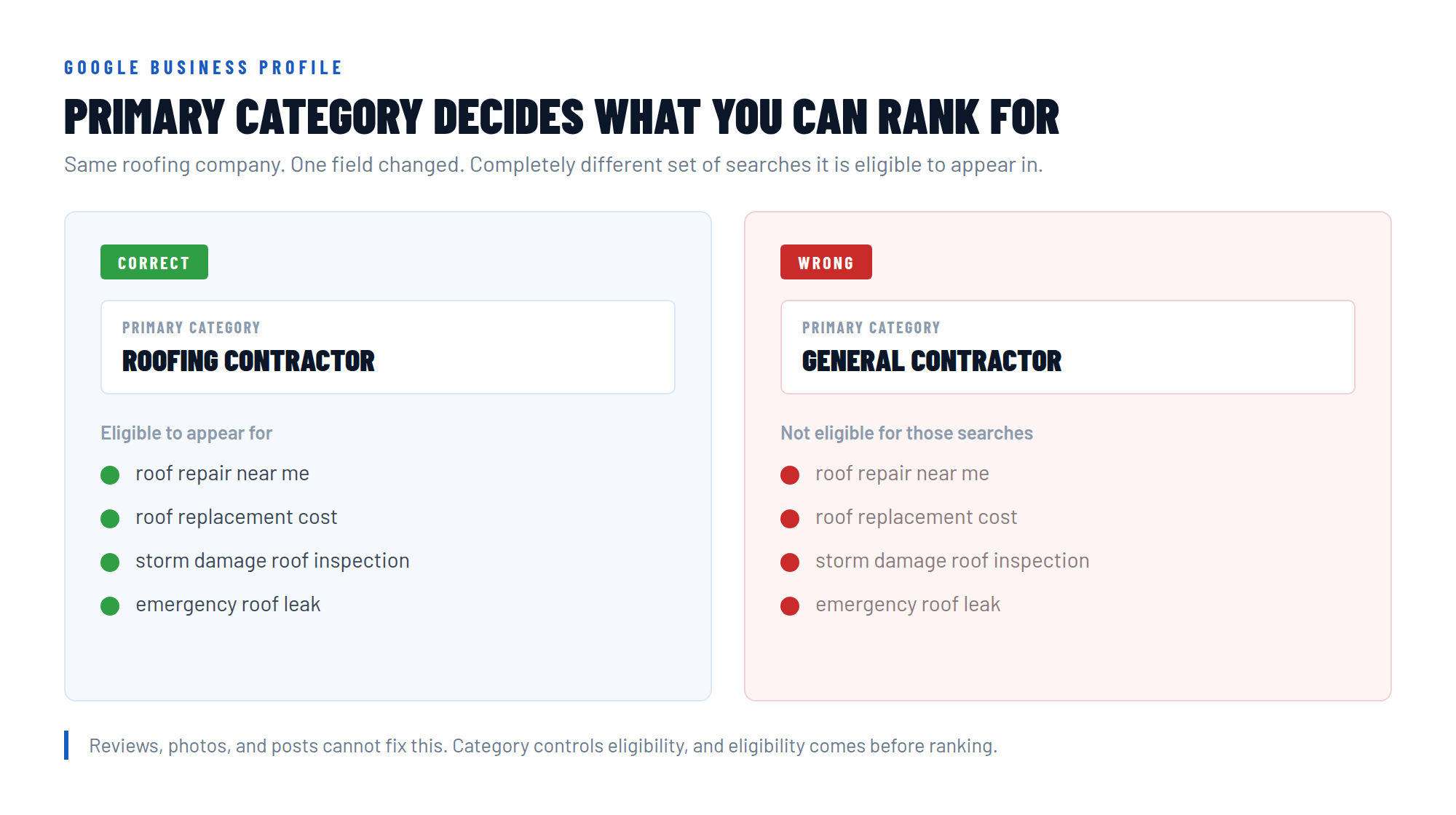
Go to your profile, look at the primary category, and then search your main service in Google Maps and look at the top three results. Click each one and check what category they use. If yours does not match, that is your answer.
Change the primary category and leave everything else alone for a few days. Category changes often produce visible movement inside 30 days, which makes this the highest-return single edit available on a profile.
Reason 3: You have a duplicate listing splitting your signal
Duplicates get created constantly. A previous marketing company made one. Google auto-generated one from web data. You moved offices and a listing stayed at the old address. An employee created one without telling anybody.
Duplicates hurt in two ways. Your reviews and activity split across multiple listings so neither builds enough prominence to rank, and Google may suppress one or both to avoid showing the same business twice.
Search Google Maps for your business name, your phone number, and your street address separately. Also search any name you used before, including a DBA or a previous owner's name. If you find duplicates, report each one as a duplicate through the listing's own Suggest an Edit link, or request a merge through Google Business Profile support.
Reason 4: Your profile was suspended and the email went to spam
Google suspends profiles for keyword-stuffed business names, a virtual office or coworking address, sudden bulk edits to core information, or industry-specific policy issues. The notification email is easy to miss, and plenty of owners find out weeks later when they notice the phone stopped ringing.
Sign in to Google Business Profile. A suspended listing shows a suspension notice at the top of the dashboard. A soft suspension means the profile is still live but you have lost management access. A hard suspension means the listing is gone from Maps entirely.
The part people get wrong
Reinstatement is a documentation exercise, not an argument. Google wants a business license, a utility bill at the address, signage photos, and vehicle photos if you run a service fleet. Fix whatever triggered it before you appeal, because appealing without correcting the cause almost always fails and repeated failed appeals make the case harder.
Reason 5: You are searching from the wrong place
If your listing shows up when you search the business name but not for your services, proximity may be doing most of the work here, and proximity is the one ranking factor nobody controls.
Google shows results near the searcher. A plumber in west Frisco can rank first for somebody standing in west Frisco and be invisible to somebody standing in east Plano, and both results are correct. This is why checking your own rankings from your own office is misleading. You are always standing at the most favorable point on the map.
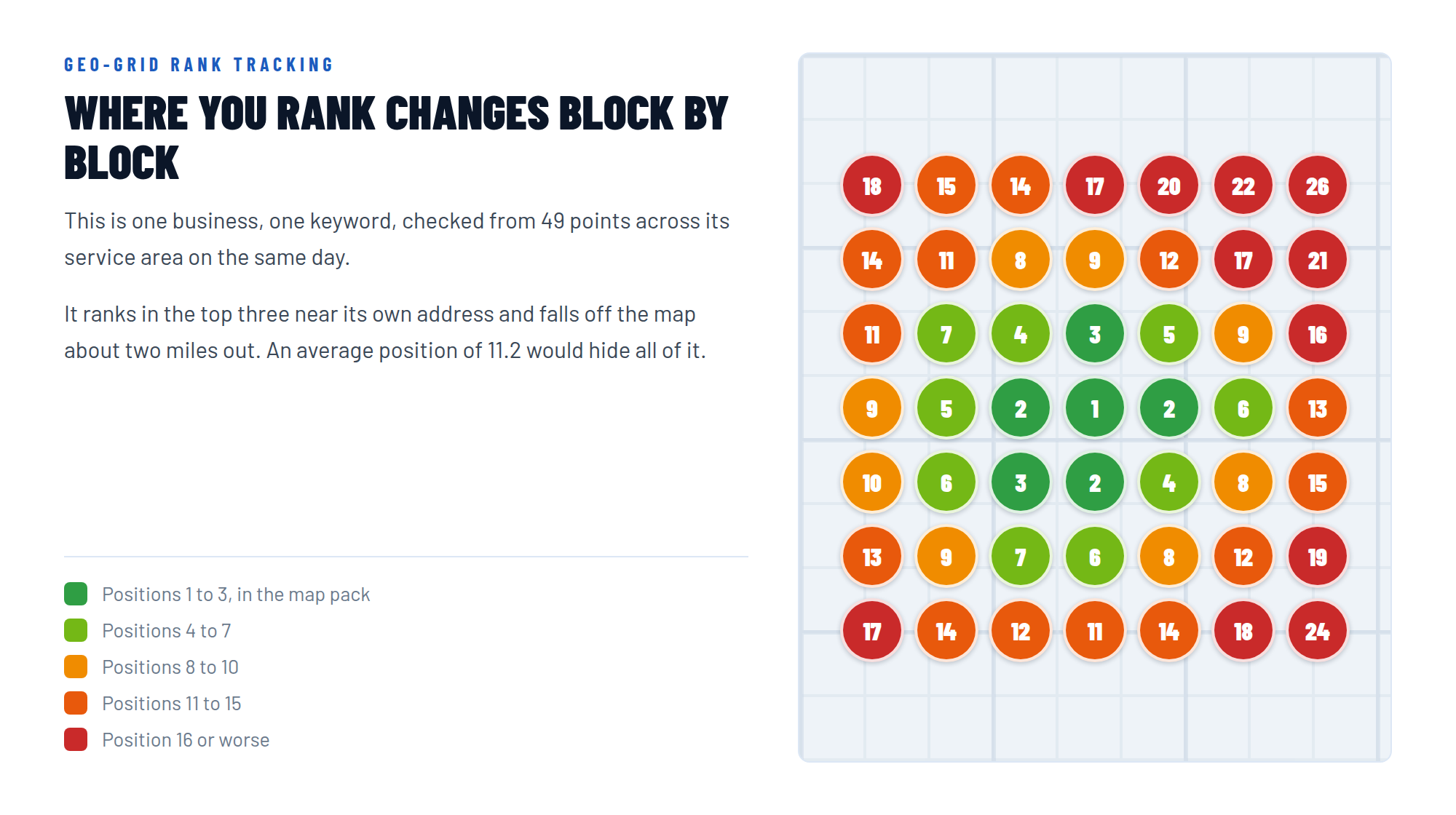
Geo-grid tracking solves this. It checks your rank from dozens of points across your service area and returns a map showing where you actually win and where you disappear. It usually reveals that a business ranking well is only ranking well within about a mile of its own front door.
Reason 6: Your service area is set too wide
Service area businesses get to hide their address and set a radius instead. The instinct is to set that radius as large as possible, because more coverage should mean more customers.
It works the other way around. A service area covering all of Dallas-Fort Worth tells Google you are moderately relevant everywhere, and moderately relevant loses to specifically relevant every time. A tighter service area concentrates the signal into the places you can actually win.
Set your service area to the cities where you genuinely want to work and can realistically serve. For most DFW service businesses that is somewhere between five and twelve cities, not the entire metroplex.
Reason 7: Your name, address, and phone don't match elsewhere
Google cross-references your profile against other sources: your website, Yelp, Bing Places, Apple Business Connect, the Better Business Bureau, industry directories, and data aggregators. When those sources disagree, Google's confidence in your listing drops, and lower confidence means lower placement.
The mismatches are usually small. A suite number on one listing and not another. A tracking number in one place and the real number somewhere else. Ste versus Suite. Individually trivial, collectively a real drag on a listing that should be ranking better than it does.
Pick one exact format for your name, address, and phone number, then make every listing match it, starting with your own website footer.
Reason 8: The profile is technically fine but thin
Sometimes nothing is broken. The profile is verified, the category is right, there are no duplicates. It is just empty.
An empty services section, three photos from 2021, no posts in eight months, four reviews with no responses. Google treats profile completeness and recent activity as signals, and a thin profile loses to a complete one even when everything else is equal.
The services section is the biggest miss we see. Most profiles list service names with no descriptions, and plenty list nothing at all. Each service allows a 300-character description, and filling out fifteen services gives Google roughly 4,500 additional characters of relevant text about your business. It takes about an hour and almost nobody does it.
How to diagnose this in fifteen minutes
Work through these in order and stop when you find the problem.
- Search your exact business name in Google Maps. No result means verification, suspension, or duplicate. Go to steps 2 through 4.
- Sign in to Google Business Profile and look for a verification prompt or a suspension notice at the top of the dashboard.
- Search your phone number, your street address, and any former business name in Maps to find duplicates.
- Check your primary category against the top three results for your main service. Fix it if it does not match.
- Check your service area. Trim it to the cities you actually serve.
- Compare your name, address, and phone across your website, Yelp, Bing, and Apple. Standardize on one format.
- Count your photos, services, and posts. If services are empty, that is your next hour of work.
- Ask somebody in a different part of town to search your main service and tell you what they see.
That last step is the one people skip, and it is the fastest reality check available. Your own search results are shaped by your location and your history with your own brand. Somebody else's are not.
What if you fix everything and still don't show up?
Then you are in a prominence problem, and prominence takes time. Google weighs how established and well-regarded your business appears across the whole web: review volume and velocity, how consistently you are mentioned, whether your website supports what your profile claims, and how much activity the profile shows.
Prominence typically builds over three to six months. There is no shortcut, and anybody selling you one is selling something that will get your profile suspended.
The pattern we see most often is a profile that was fixed correctly but then left alone. Category corrected, duplicates removed, and then nothing for six months. Profiles need maintenance the same way a website does, which is why our Google Business Profile management work is ongoing rather than a one-time cleanup, and why the SEO side and the profile side get worked together instead of separately. If you are weighing whether to hand that off, we published what local SEO and profile management actually cost, including the ranges other providers charge.
If you want this broken down for your specific trade, we have pages for pest control, plumbing, dental, roofing, legal, and HVAC.
And if the honest conclusion is that you would rather hand this to somebody, the hiring decision has its own traps. We wrote up the nine questions worth asking an SEO company, including the account ownership rule that decides how much leverage you have if it ever ends badly.
Frequently asked questions
How long does it take for a new Google Business Profile to show up on Maps?
Usually a few days to two weeks after verification completes. If it has been longer than that and the listing still does not appear when you search your exact business name, check for a duplicate listing or a suspension notice rather than waiting it out.
Why does my business show up for my name but not for my services?
That is a relevance and prominence issue, not a visibility issue. The most common causes are a wrong primary category, an empty services section, and low review volume compared to the businesses currently ranking. Category is the first thing to check because it determines which searches you are eligible for at all.
Can I rank in Google Maps without a physical address?
Yes. Service area businesses can hide the address and set a service radius instead. You still need a real address for verification, but it will not display publicly. Keep the service area to the cities you genuinely serve, because an oversized area dilutes your relevance everywhere inside it.
Does posting on Google Business Profile actually help rankings?
Posts are not a strong direct ranking factor on their own, but they contribute to the activity and completeness signals that do matter, and they occupy space on your profile that would otherwise sit empty. Weekly is a reasonable cadence. Monthly is better than nothing.
Why do I rank first from my office but not from across town?
Proximity. Google shows results near the searcher, so your position genuinely changes based on where the person is standing. Checking your rank from your own office always flatters you. Geo-grid tracking across your service area gives you the honest picture.
Should I delete my old listing and start over?
Almost never. A listing carries review history and age, and starting over throws both away. Merging a duplicate into your primary listing preserves the reviews. Deleting and recreating also raises suspension risk on the new listing.
Want a second set of eyes?
We do free profile audits. You get the top issues ranked by impact and a plain explanation of what each one is costing you. If your current setup is solid, we will tell you that.
Start a conversationLocal to Frisco?
Our Frisco SEO company page →