
Blog / Local SEO
How Much Does SEO Cost?
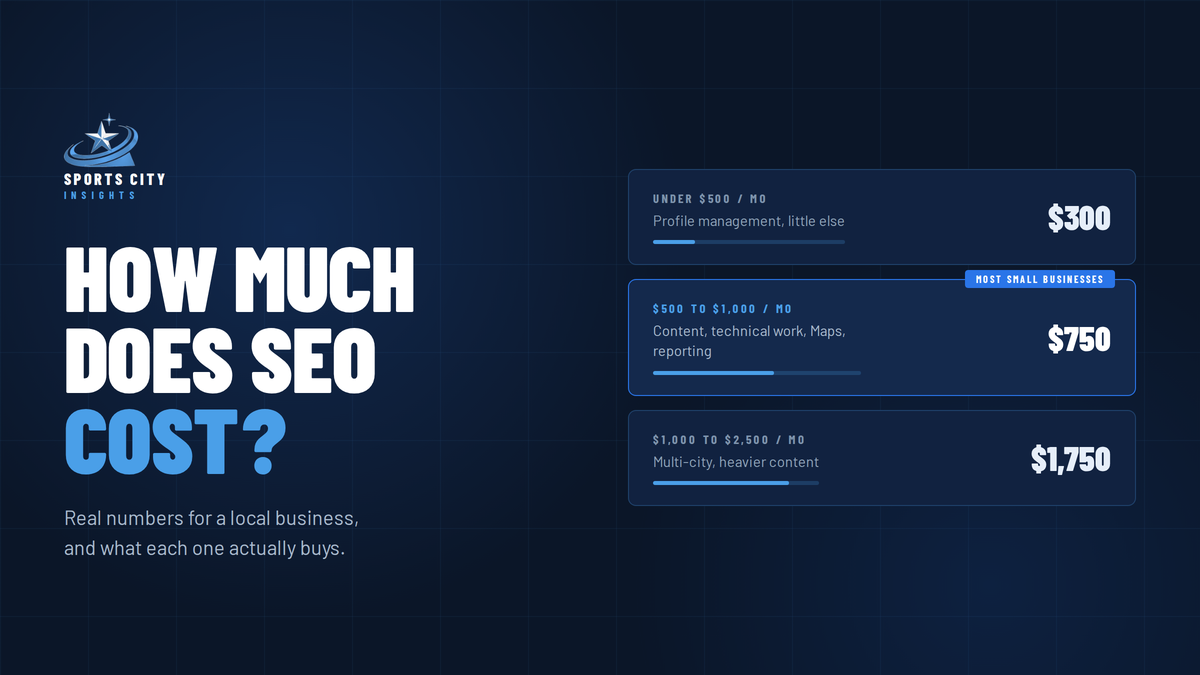
Ask five SEO companies what they charge and you will get five versions of the same answer: it depends. That is technically true and completely useless to somebody trying to build a budget.
It stays vague on purpose. If nobody publishes a number, nobody gets compared, and the first real number you hear arrives on a sales call after you have already spent forty minutes explaining your business. By then the price is anchored to how much the seller thinks you can pay rather than how much work the job takes.
So here are the numbers. What the market actually charges, what each budget band buys a small business, what we charge and why it is printed on our own site, and how to tell whether the invoice you are already paying is fair.
What most small businesses actually pay
The most useful public dataset on this comes from Ahrefs, who polled 439 SEO service providers about their own pricing. Published in December 2023 and last updated in August 2024, so treat it as a recent baseline rather than this morning's market, but the shape of it matches what we see.
The single most common monthly retainer band was $501 to $1,000. The average agency retainer came in far higher at $3,209 a month, which tells you the top of the market drags the average a long way from the middle. Hourly work clustered at $75 to $100. One-time projects clustered at $2,501 to $5,000. You can read the full survey breakdown at Ahrefs.
For a single-location local business in a normal trade, the honest working range is $500 to $1,500 a month. Below $500 you are usually buying a checklist someone runs in twenty minutes. Above $1,500 you should be getting content production, real technical work, or multi-location coverage, and you should be able to point at which one.
The number that matters more than the price
SEO is only expensive relative to what a customer is worth to you. A roofer at a $9,000 average job needs one extra customer a year to cover a $600 monthly program. A coffee shop at a $6 ticket needs a very different conversation.
The four ways SEO gets priced
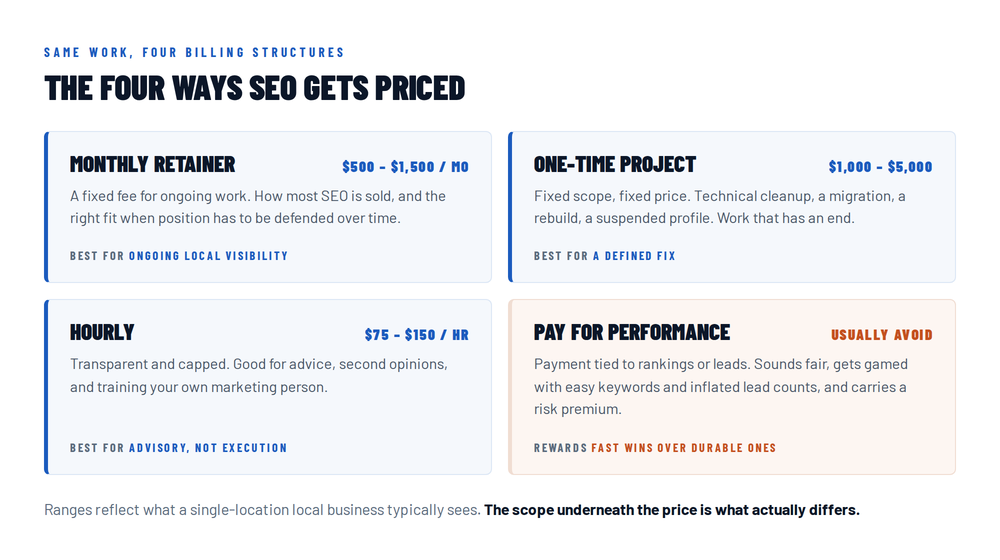
Monthly retainer
A fixed monthly fee for ongoing work. This is how the large majority of SEO is sold, and for good reason: search results move continuously, competitors keep publishing, and Google keeps changing. It is the right structure for a business that wants position defended rather than a one-time push.
The risk is the autopilot retainer, where months four through twelve look suspiciously like month three and nobody can name what changed. A retainer should come with a plan you can read and a report you can understand.
One-time project
A fixed scope with a fixed price. Technical cleanup, a migration, a site rebuild, a Google Business Profile that needs rescuing. This is the correct structure whenever the work has an end. Nobody should pay a monthly fee forever for a fix that took one week.
Hourly
Best for advisory work, second opinions, and training your own marketing person. Honest and transparent, and it caps your exposure. It is a bad fit for execution, because you end up paying for the slow parts and quietly discouraging the work from getting done thoroughly.
Pay for performance
Payment tied to rankings or leads. It sounds like the fairest model on the list and it is usually the worst deal on it. Rankings get gamed with keywords nobody searches. Lead counts get inflated with form spam and misrouted calls. And the provider carries all the risk, so they price for it, which means when it works you pay a large premium.
There is also a structural problem. The provider needs fast wins to get paid, and fast wins and durable wins are frequently different work.
What actually moves the number
Five things explain almost every price difference you will encounter. When a quote surprises you, the answer is in here.
Competition in your market
Ranking a dog walker in a suburb and ranking a personal injury attorney in Dallas are not the same job and cannot cost the same. Legal, cosmetic medical, restoration, and home services in a major metro are the expensive end. Niche B2B and low-competition trades are the affordable end.
How many locations and cities
One location in one city is one job. Three locations across five suburbs is a different one, with more profiles to manage, more pages to build, and more places for your business details to disagree with each other.
The condition of the site you already have
This is the one that catches people. A fast, well-structured site is ready for SEO on day one. A slow site on an abandoned theme with broken pages needs repair before optimization means anything, and that repair shows up either as a project fee or as the first two months of the retainer.
Whether content is included
The single largest cost variable. Written content is labor, and labor is what you are buying. A $600 program with four pages of new content a month and a $600 program with none are not the same product at the same price. Ask which one you are being quoted.
Whether the site is being managed too
Plenty of SEO quotes assume somebody else keeps the website updated, secure, backed up, and online. If nobody does, that is a separate line item. We price website management on its own starting at $200 a month for that reason, so it is visible rather than buried.
What each budget band really buys
Rough guide for a single-location local business. Trade, city, and site condition all shift it, but this is the shape of what your money gets.
| Budget | What it realistically covers | Best fit |
|---|---|---|
| Under $500 | Google Business Profile management, review requests, listing accuracy, light reporting. Little to no new content or technical work. | A business whose website is already fine and whose problem is Maps visibility |
| $500 to $1,000 | Profile management plus on-page optimization, a few new or rewritten pages a month, technical fixes, internal linking, and reporting a human explains. | Most single-location service businesses. This is the band most small businesses belong in. |
| $1,000 to $2,500 | Everything above, plus consistent content production, multi-city or multi-location coverage, deeper technical work, and link acquisition. | Competitive trades, several service areas, or a business trying to take share rather than hold it |
| $2,500 and up | Larger content programs, digital PR, ecommerce or enterprise technical work, and a team rather than one person. | Multi-location operators, ecommerce, and high-value national or metro-wide competition |
Maps-only management sits at the bottom of this table on purpose. If Google Maps is your whole problem, profile management at $350 a month solves more than a broad program at twice the price.
Where the money goes inside a retainer
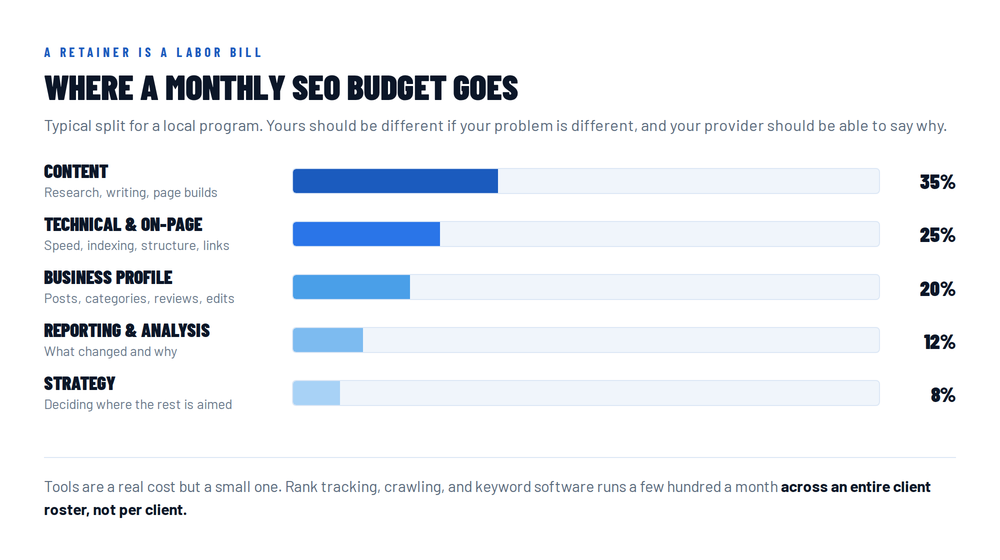
An SEO retainer is a labor bill. Almost all of it is somebody's time, and it lands in five buckets.
Content is usually the largest. Researching what people search, then writing pages and posts that answer it. This is where a program either compounds or stalls.
Technical and on-page covers page speed, crawl and index problems, titles and headings, internal linking, schema, and the structural work that decides whether your content ever gets read.
Google Business Profile is posts, photos, categories, services, Q&A, review responses, and watching for the edits Google makes to your listing without telling you.
Reporting and analysis is the part clients underrate and providers hide behind. A dashboard is not a report. A report says what changed, what caused it, and what happens next.
Strategy is the smallest slice in hours and the one that decides whether the other four were aimed at anything.
Tools are a real cost too, though a smaller one than agencies imply. Rank tracking, crawling, and keyword research software runs a few hundred dollars a month across an entire client roster, not per client.
What we charge, and why we publish it
Our pricing is on the site because we would rather lose a bad fit before the first call than discover it in month three. Every number below is public on our services page and every program runs month to month.
- Website Management, $200 to $500 a month. Updates, hosting, security, backups, uptime monitoring, speed work, and content edits. No SEO program attached.
- Google Maps management, $350 a month. Ongoing Business Profile work. A one-time profile rescue for a suspended or hijacked listing is $600.
- Digital Growth Partner, $550 to $1,600 a month. Website management, SEO, Google Business Profile, and reporting in one program. Most clients land here.
- Web design and rebuilds, $1,000 to $2,000 to start. A refresh, a rebuild, or a new build, quoted by scope.
The $550 entry on the Digital Growth Partner program is deliberately close to that $501 to $1,000 band, because that band is where most local businesses actually belong and pricing above it would be pricing for the sales call rather than the work.
We also do not require a contract. The reasoning is on our how we work page, and it is simple: a twelve-month agreement mostly protects the agency from the consequences of month four.
Seven things that should end the conversation
None of these are about price. They are about what the price is buying.
- A guaranteed number one ranking. Nobody controls Google's results. A guarantee means either the keyword is worthless or the promise is.
- Per-keyword billing. Optimizing a page lifts it for dozens of related searches. Charging per keyword bills you repeatedly for one piece of work.
- A long contract with no exit. Six or twelve months locked in is a request for patience before any has been earned. Month to month is normal now.
- You do not own your accounts. If the agency owns your Google Business Profile, your domain, your analytics, or your website, leaving costs you the asset. This is the most expensive mistake on the list.
- Reports that only show rankings. Rankings move for reasons that have nothing to do with your business. Calls, forms, and revenue are the point.
- No named person doing the work. Ask who touches your account and how often. Vagueness here usually means overseas subcontracting nobody is checking.
- They will not say what happens in month one. A provider who has done this before can describe the first thirty days in detail before you sign anything.
How to tell if you are overpaying
If you are already paying somebody, you can answer this in an afternoon without cancelling anything.
- Add up twelve months of invoices. That is the real number, and it is usually larger than the one in your head.
- Open Google Search Console and compare the last three months against the same three months last year. Clicks and impressions, not rankings. If both are flat, the program is not working, whatever the report says.
- List what was produced in the last ninety days. Pages published, fixes made, profile work done. If you cannot list it, ask for it in writing and see what comes back.
- Divide the annual spend by the customers you can trace to search. Compare that to what a customer is worth. This single number settles most of these arguments.
- Confirm you own the accounts. Google Business Profile, Search Console, Analytics, the domain, and the website. Check this even if you are happy.
Before you increase a budget, rule out the cheap explanations. A business that is invisible on Maps often has a profile problem rather than a budget problem, and we listed the eight causes worth checking in order. Listings that contradict each other are a free fix too, and the citation audit takes about an hour. Neither requires spending another dollar.
If you want to see what a program actually produced rather than what it promised, our results page shows the measurement windows alongside the numbers.
And if the conclusion is that you need a different provider rather than a different budget, the nine questions worth asking before you sign will get you a set of quotes you can actually compare.
Frequently asked questions
How much does SEO cost per month for a small business?
Most single-location local businesses land between $500 and $1,500 a month. In the Ahrefs survey of 439 providers the most common retainer band was $501 to $1,000. Under $500 usually buys profile management and little else, and above $1,500 you should be getting content production, technical work, or multi-location coverage.
Is cheap SEO worth it?
Cheap and limited is fine. Cheap and vague is not. A $300 program that only manages your Google Business Profile and says so is a reasonable purchase. A $300 program that claims to do everything is selling you twenty minutes of automated work a month.
How long before SEO pays for itself?
Local SEO typically shows movement in three to six months and meaningful return between six and twelve. Profile and listing fixes can move faster, sometimes in weeks. Anything promising results in thirty days is either targeting searches nobody makes or counting on you not to check.
Should I pay monthly or for a one-time project?
Pay by project when the work has an end, like a technical cleanup, a migration, or a profile rescue. Pay monthly when you need position defended over time. Paying a retainer forever for work that finished in week two is the most common way small businesses waste this budget.
Why do SEO quotes vary so much for the same business?
Because the scope underneath them is different and rarely spelled out. The biggest swing is content. A quote that includes four new pages a month and one that includes none can carry the same price and be different products. Ask every provider to put deliverable counts in writing and the quotes become comparable.
Can I do local SEO myself?
Real parts of it, yes. Claiming and completing your Google Business Profile, asking customers for reviews, and making your listings agree with each other are free and account for a good share of local visibility. The parts that need help are technical repair, sustained content, and knowing which of the twenty possible problems is actually yours.
Want to know what your situation should cost?
Our free audit reviews your website and Google Business Profile and comes back with the issues ranked by impact, plus a straight answer on what fixing them takes. If your current provider is doing good work, we will tell you that instead.
Start a conversationRead this next
How to Choose an SEO Company →Local to Frisco?
Our Frisco SEO company page →