
Blog / Local SEO
How to Choose an SEO Company
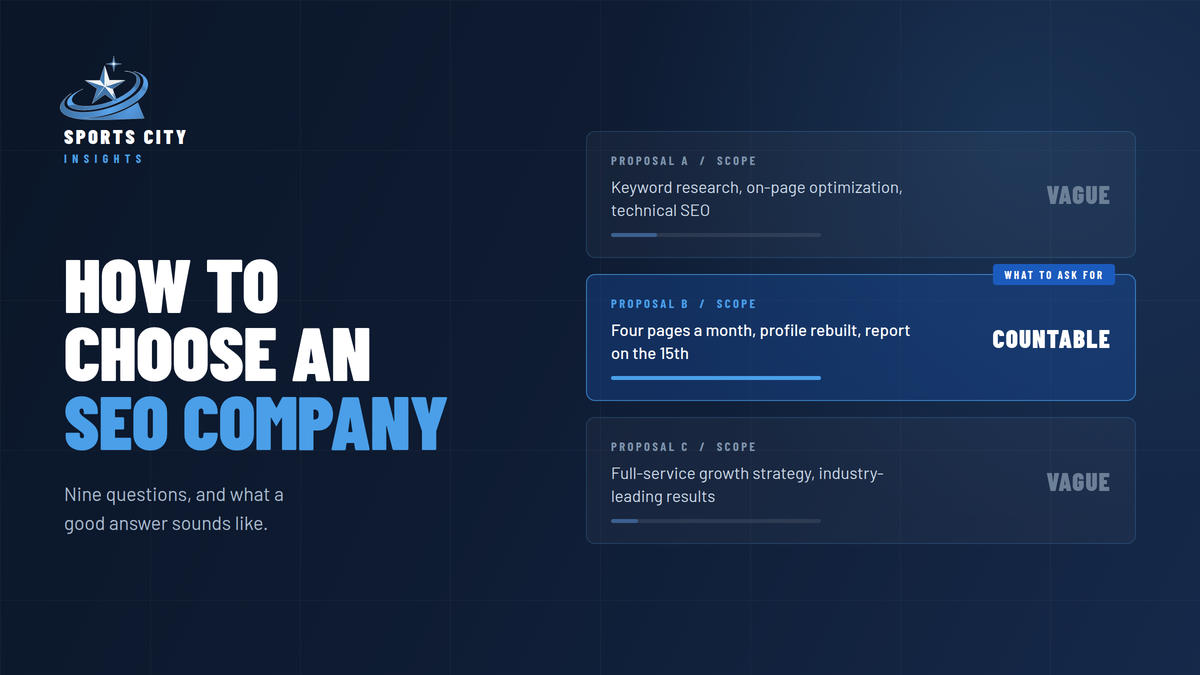
Every SEO company you call will tell you they do keyword research, on-page optimization, technical SEO, content, and link building. All five phrases are real. None of them tell you whether the person saying them will do anything useful for your business.
That is the actual problem with hiring for this. You are buying something you cannot inspect, from someone whose work you cannot evaluate, in a field with no licensing and no standard vocabulary. A great provider and a terrible one describe their service using identical words.
So stop trying to judge the pitch. Judge what they will commit to producing, who owns the accounts when it ends, and whether they can explain your specific situation back to you before they quote it. Those three things separate providers faster than any amount of discovery-call conversation.
Decide what you are buying before you take a call
Three genuinely different problems get sold under the same two letters. Work out which one is yours first, because it changes who you should be talking to and what a fair price looks like.
You are invisible in Google Maps. Customers searching your service plus your city do not see you in the map results, even though you are two miles away. This is Google Business Profile work, and a meaningful share of it is free and self-serviceable. Before you pay anyone, run through the eight causes worth checking in order. If the fix turns out to be a wrong primary category, you do not need a retainer.
Your website does not rank for the services you sell. You show up for your own business name and nothing else. This is content and site structure work, it is slower, and it is where most of the money in a real SEO program goes.
Your website is the problem. Slow, broken on phones, on an abandoned theme, half the pages 404. No amount of optimization fixes a site that needs repair, and a provider who quotes an SEO retainer without mentioning the condition of the site either did not look or is planning to bill you for months of cleanup as though it were strategy. Repair and upkeep are a separate line item, which is why we price website management on its own rather than folding it in where you cannot see it.
Why this matters before the first call
A provider who asks which of the three you have is doing diagnosis. A provider who quotes a monthly number before asking is selling a package. You can tell them apart in the first ten minutes.
The four kinds of provider
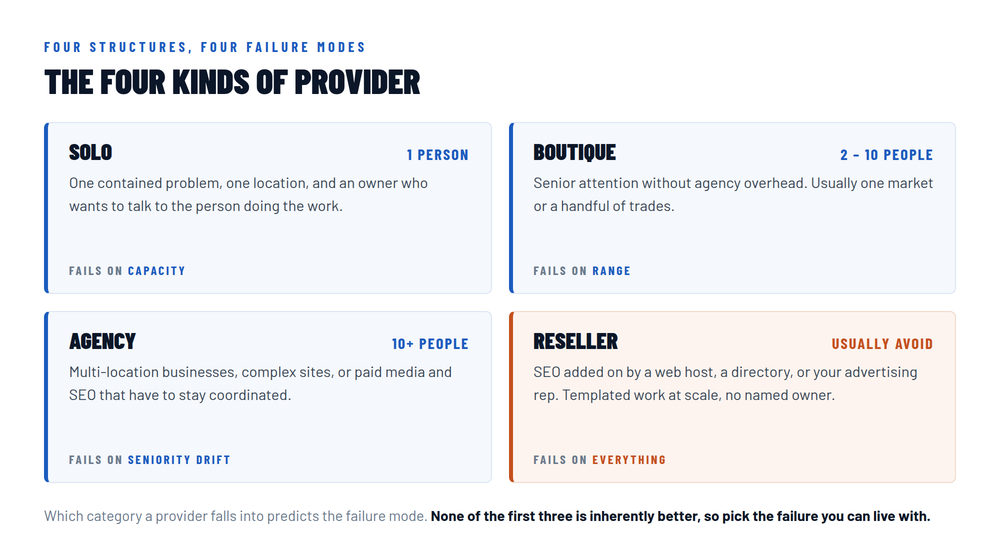
The category a provider falls into predicts their failure mode better than anything on their website.
| Type | Best fit | The usual failure mode |
|---|---|---|
| Solo | A single location with a clear, contained problem and an owner who wants to talk to the person doing the work | Capacity. One person with eight clients handles a busy month badly, and there is nobody to cover a vacation or an illness |
| Boutique | Local businesses that want senior attention without agency overhead. Two to ten people, usually one market or a few trades | Range. A small shop good at local search may not have a developer when your site needs one |
| Agency | Multi-location businesses, complex sites, or companies that need paid media, design, and SEO coordinated | Seniority drift. The person who won the account is not the person who runs it, and a small budget gets the newest employee |
| Reseller | Almost nobody, deliberately. This is SEO sold as an add-on by a web host, a directory, a phone book successor, or your advertising rep | Everything. Templated work at scale, no named owner, and reporting built to look busy rather than to be read |
The reseller category is the one that catches small businesses most often, because the offer arrives from a company you already pay for something else and therefore already trust.
None of the first three is inherently better. The question is which failure mode you can live with. If you need one person who knows your business and answers the phone, a large agency is a bad fit at a small budget no matter how good the agency is.
For the record, we are the second row. That is a disclosure rather than a pitch, and it is the reason our service list is short and our pricing is printed instead of quoted on a call.
Nine questions, and what a good answer sounds like
Ask these on the first call. You are not testing their knowledge, you are testing whether their answers are specific. Vagueness is the signal.
- Which of my problems are you solving first, and why that one? A good answer names one thing, explains why it comes before the others, and references something they actually saw on your site or profile. A bad answer is a list of five services in the order they appear on their pricing page.
- What exactly will you produce in the first ninety days? You want counts and names. Four pages, a technical fix list, the profile rebuilt, a report on the fifteenth. If nobody will put a number next to a deliverable, there is no way to tell later whether you got what you paid for.
- Who does the work, and where do they sit? Outsourcing is not automatically a problem. Undisclosed outsourcing is. Ask who writes the content and who touches the website, and ask it plainly.
- What will you report, and can I see a real example? Ask for a redacted report from a current client. A provider who reports honestly has one ready. A provider who does not will offer to describe it instead.
- Who owns the accounts? Covered in detail below. The correct answer is you, in every case, with no exceptions offered.
- How will we know at month six whether this worked? The answer should involve Search Console clicks, calls, forms, or booked jobs. If it is rankings alone, you are about to pay for movement on terms nobody searches.
- What have you done for a business like mine? Like yours means comparable competition and comparable geography, not the same industry. Ranking a plumber in a suburb and a plumber in Dallas are different jobs. Ask to speak to one client.
- What is your policy on links? You want to hear that links are earned through content, digital PR, local sponsorships, or genuine partnerships. If you hear about a network, a package of a hundred links, or a monthly link quota, end the call. Google's spam policies treat paid and manufactured links as a violation, and the penalty lands on your domain, not theirs.
- What happens if I want to stop? Ask about notice period, early termination fees, and what you keep. Then ask them to send it in writing.
The single best question on the list
Number two. Everything else can be answered smoothly by a good salesperson. Specific deliverable counts in writing are the only part of a pitch that can be checked against reality ninety days later.
What Google itself tells you to watch for
Google publishes its own guidance on hiring an SEO, and it is worth reading before you take any calls because it is short, vendor-neutral, and names specific behavior. The warnings it gives are:
- Unsolicited contact. Google's wording is to be wary of firms that email you out of the blue. Legitimate providers do not cold-blast inboxes claiming to have noticed problems with a site they have never opened.
- Guaranteed rankings. Google states plainly that no one can guarantee a number one ranking. Any guarantee of position is either meaningless or attached to terms nobody searches.
- A claimed special relationship with Google. There is no priority submission, no insider channel, and no agency with a back door. Being a Google Partner is a paid advertising credential and has nothing to do with organic rankings.
- Secrecy about what they will do. Google flags providers who will not clearly explain their intended work. Proprietary process is a reasonable thing to have. Refusing to describe what will change on your website is not.
- Link popularity schemes and mass submission. Submitting your site to thousands of search engines is a service that stopped meaning anything two decades ago and is still being sold.
You can read Google's full guidance on hiring an SEO in about five minutes. If a provider's pitch contradicts something on that page, that is a straightforward reason to walk.
The ownership question nobody asks until it is too late
This is the part that turns an ordinary bad engagement into an expensive one. When a relationship ends badly, the leverage is in whose name the accounts are in, and most small business owners do not find out until they try to leave.
You should be the owner of record on every item below, with the provider added as a manager or user. Not the other way round.
- The domain name. Registered to you, in an account you can log into. A domain held in an agency's registrar account is the single worst version of this problem.
- Hosting and the website itself. Including an administrator login and a copy of any custom work you paid for.
- Google Business Profile. You are the primary owner, the provider is a manager. Primary ownership can be transferred, so check it rather than assume it.
- Google Search Console. Verified by you as an owner, not added as a user by them. This is also your only free source of historical search data, and it does not transfer.
- Google Analytics. The property sits in an account you control. A property inside an agency's account leaves with the agency.
- Any advertising accounts. Same rule, and the billing profile matters as much as the account.
- The content. Pages, posts, photos, and video you paid to have produced should be yours outright, in writing.
A two-minute test you can run today
Try to log into your own Google Business Profile and Search Console right now, from your own email, without asking anybody for help. If you cannot, you have found a problem worth fixing this week regardless of whether you are happy with your provider.
Nothing here requires distrust. Good providers set these up correctly in the first week and will tell you so unprompted. It is a five-minute conversation that removes the only real risk in the arrangement.
How to read the proposal
Most SEO proposals are long because length reads as value. Skip to four things.
- The deliverables, with counts. Pages, posts, fixes, profile work, reports, and how often. If the scope section is a list of capabilities rather than a list of outputs, you cannot compare it to anything, including the invoice.
- The named person. Who runs the account and how you reach them. A shared inbox is not an answer.
- The reporting cadence and what is in it. Monthly is standard. The report should show clicks and impressions from Search Console, work completed, and what comes next. Rankings alone are decoration.
- The term and the exit. Notice period, termination fee, automatic renewal, and what transfers back to you.
Once you have that from two or three providers, the quotes become comparable, and price differences usually explain themselves. Quotes that looked wildly apart often turn out to be the same number for different amounts of content. We went through what SEO actually costs a small business, what each budget band buys, and the pricing red flags separately, because the money question deserves its own answer.
What the first ninety days should look like
You cannot judge SEO results in ninety days, but you can absolutely judge the work. Here is what a competent start produces.
Month one is diagnosis and repair. A technical crawl, a Google Business Profile review, listing accuracy, and a baseline pulled from Search Console so there is something to measure against later. Fixes begin. Nothing about this month should be a surprise, and you should receive the baseline numbers rather than hear that they were taken.
Month two is building. Pages written, profile completed, listings corrected, internal linking sorted. If your listings still contradict each other at the end of month two, that is a straightforward miss, and the citation audit that catches it takes about an hour.
Month three is the first real report. Impressions usually move before clicks, and clicks before calls. Movement on impressions at ninety days is a reasonable early signal. Flat impressions at ninety days is a conversation worth having.
Meaningful return on local SEO generally lands between six and twelve months. Anyone promising revenue change in thirty days is either targeting searches nobody makes or counting on you not to check. That is also why we publish our measurement windows next to the numbers on our results page rather than the numbers alone.
If you already have a provider
Most people reading this are not hiring their first SEO company. They are trying to work out whether to keep the one they have. Do this before you cancel anything.
- Confirm ownership first. Run the two-minute test above. Sort out any account you do not control while the relationship is still cordial. This is much harder after you give notice.
- Pull your own baseline. Open Search Console and compare the last six months against the same six months a year ago. Clicks and impressions. This is your data, it is free, and it does not depend on anybody's report.
- Ask for a list of what was produced in the last ninety days. Pages, fixes, profile work. A provider doing real work answers this in a day. A provider who cannot produce the list has told you something.
- Get one outside read before you decide. A second opinion on the same site should identify roughly the same top issues. If it does not, at least one of the two people looking is wrong, and that is useful to know.
Sometimes the honest answer is that the program is fine and the expectations were wrong. A business invisible on Maps because of a category error does not have an agency problem, and neither does a business that hired for content and is disappointed about Maps. Diagnose before you switch.
If you are in the north Dallas suburbs and want the local version of this, our Frisco SEO company page lays out how we work with businesses here, and the Google Business Profile and SEO pages spell out what is actually included at each tier.
Frequently asked questions
How do I know if an SEO company is legit?
Legitimacy shows up in specificity, not credentials. A legitimate provider names which problem they are solving first, commits to deliverable counts in writing, sets the accounts up in your name, and reports Search Console data you can verify yourself. Google's own guidance adds the negative test: no guarantees of ranking position, no claimed special relationship with Google, no secrecy about what they will change, and no link schemes.
Should I hire a local SEO company or does location not matter?
For the work itself, location does not matter. Search Console, your website, and your Google Business Profile are all reachable from anywhere. Where local helps is knowledge of the market you compete in and the ability to meet when something is complicated. Hire for the quality of the answers, not the mileage.
How long should I give a new SEO company before judging it?
Judge the work at ninety days and the results at six to twelve months. At ninety days you should be able to list what was produced and see movement in impressions. If you cannot list the work at ninety days, the timeline is not the problem.
Is a long-term contract ever reasonable?
For a fixed-scope project with a defined end, like a site rebuild or a migration, a term makes sense because the work is front-loaded. For an ongoing monthly program it is a request for patience before any has been earned. Month to month is normal now, and we run every program that way.
What should I ask for before I sign?
Four things in writing: the deliverables with counts for the first ninety days, the named person running the account, what the monthly report contains, and the exit terms. Providers who are comfortable with all four send them the same day.
Can I just do it myself?
Parts of it, genuinely. Claiming and completing your Google Business Profile, asking customers for reviews, and making your listings agree with each other are free and account for a real share of local visibility. The parts that usually need help are technical repair, sustained content production, and working out which of twenty possible problems is actually yours.
Want a second opinion before you sign anything?
Our free audit reviews your website and Google Business Profile and comes back with the issues ranked by impact, plus a straight answer on what fixing them takes. If your current provider is doing good work, we will tell you that instead. Published pricing, month to month, no contracts.
Start a conversationRead this next
How Much Does SEO Cost? →How we run it
See how we work →