
Blog / Local SEO
Local Citations: Which Ones Actually Matter
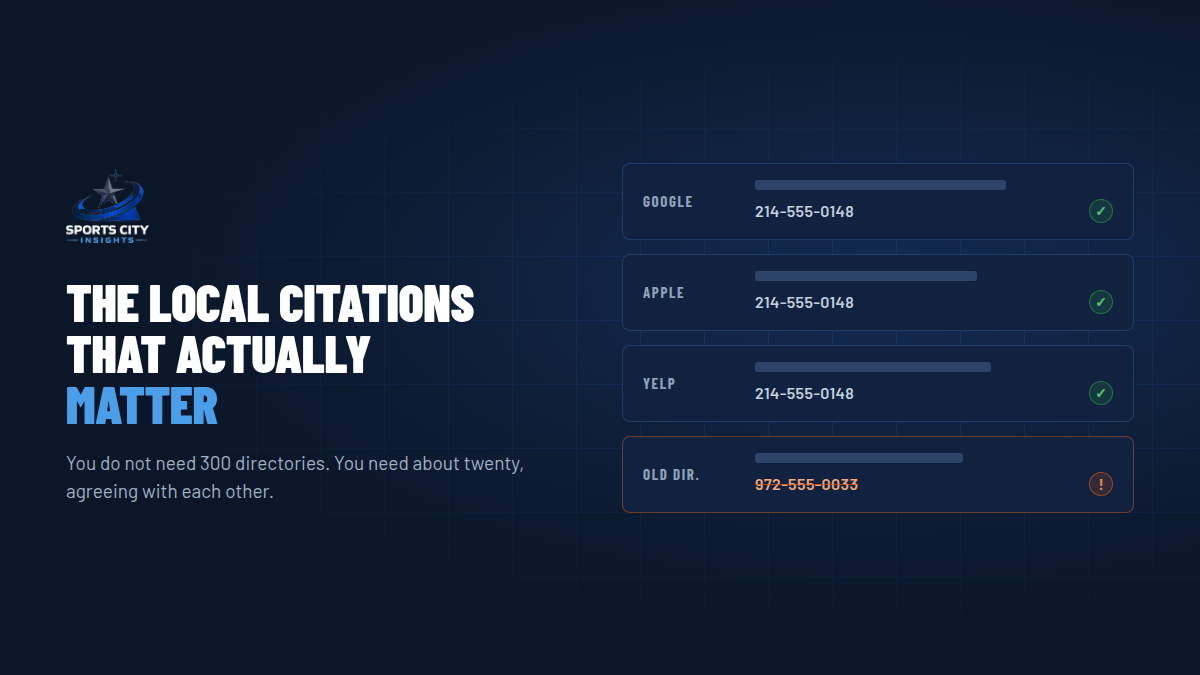
A local citation is any place your business name, address, and phone number appear together online. Your Google Business Profile is one. So is your Yelp page, your listing on the chamber of commerce site, and that directory a marketing company submitted you to in 2019 that you forgot exists.
The citation industry would like this to be complicated, because complicated sells. It is how you end up with packages promising placement in 300 directories, and monthly invoices for maintaining listings nobody has visited since they were created.
Here is the version we give clients. About twenty listings matter. Consistency across them matters more than adding a single one beyond them. And most businesses can audit the whole thing in about an hour.
What citations actually do
Ten years ago citation volume was a ranking lever, and the industry built itself around pulling it. That era is over. Google got dramatically better at figuring out which business is which, and a mention in the 200th directory adds nothing a mention in the 20th did not already add.
What citations still do is corroborate. When Google looks at your Business Profile, it cross-checks the details against the rest of the web. Your website, Yelp, Apple Maps, the BBB, industry directories, and the data companies that feed everything else. When those sources agree, confidence in your listing goes up. When they contradict each other, confidence drops, and low confidence shows up as lower placement and, in bad cases, as Google quietly overwriting your profile details with wrong data it found elsewhere.
There is also a customer-facing version of this that gets ignored because it is not an SEO metric. A wrong phone number in a directory is a customer who called someone else. That failure never shows up in a rankings report, and it costs more than the ranking ever did.
The one-sentence version
Citations are a trust layer, not a growth lever. You build them once, correctly, in the places that matter, and then you stop.
The three tiers worth your time
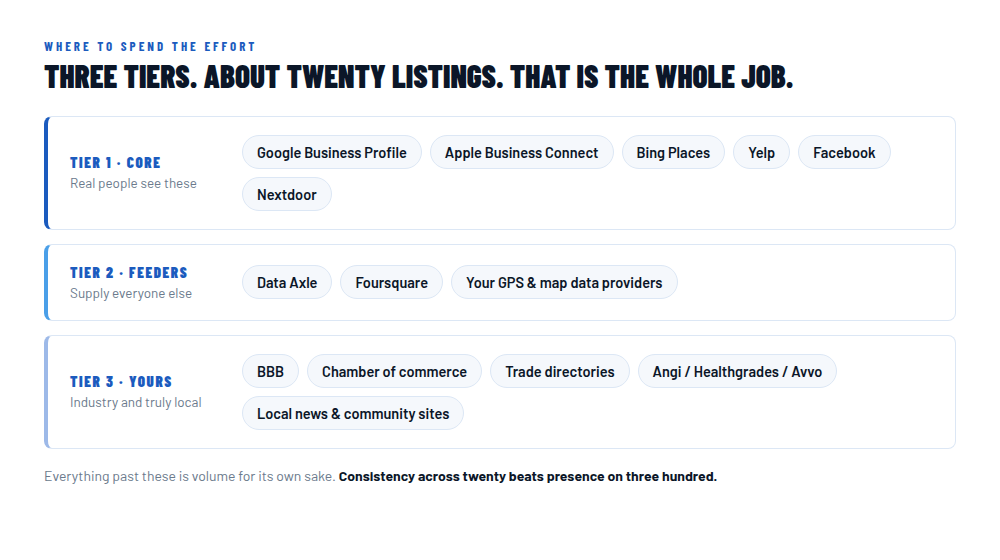
Tier 1: The core platforms real people use
Google Business Profile, Apple Business Connect, Bing Places, Yelp, Facebook, and Nextdoor. These are the listings customers actually see and the sources Google weighs most heavily. Every one of them should be claimed by you, with the login stored somewhere you can find, because an unclaimed listing is one a competitor, a disgruntled ex-employee, or a bored stranger can suggest edits to.
Apple Business Connect is the one small businesses skip most often, and it is a mistake. Every iPhone ships with Apple Maps as the default, and a meaningful share of your customers navigate to you through it whether you ever claimed the listing or not.
For the record, ours are claimed and verified on Google Business Profile, Bing Places, Yelp, and Facebook, alongside a LinkedIn company page. We list them because the advice in this section is easy to give and slightly tedious to actually do, and a page telling you to claim the core platforms should be able to say it did.
Tier 2: The data feeders
A handful of companies supply business data to thousands of downstream sites, apps, and navigation systems. In the US the ones that matter today are Data Axle and Foursquare. Get your record right at the source and corrections flow outward over the following weeks. Get it wrong there and you can fix the same error in fifty places and watch it come back.
This is also the answer to a question owners ask constantly: why does my old address keep reappearing? Because a feeder still has it, and every site that pulls from that feeder keeps reprinting it.
Tier 3: Industry and genuinely local
The BBB, your chamber of commerce, and the directories specific to your trade. Angi and HomeAdvisor for home services. Healthgrades and Zocdoc for healthcare. Avvo and FindLaw for attorneys. Plus anything genuinely local: the community business directory, the local news site that lists sponsors, the neighborhood association page.
Tier 3 is where judgment matters, because these double as referral sources. A chamber listing that sends you two customers a year is worth maintaining for reasons that have nothing to do with Google. A generic national directory with no traffic is not, and never was.
What counts as a mismatch, and what does not
NAP consistency is the most over-policed concept in local SEO. Agencies flag every trivial formatting difference as a crisis because a long list of errors justifies the invoice. Google normalizes formatting and has for years.
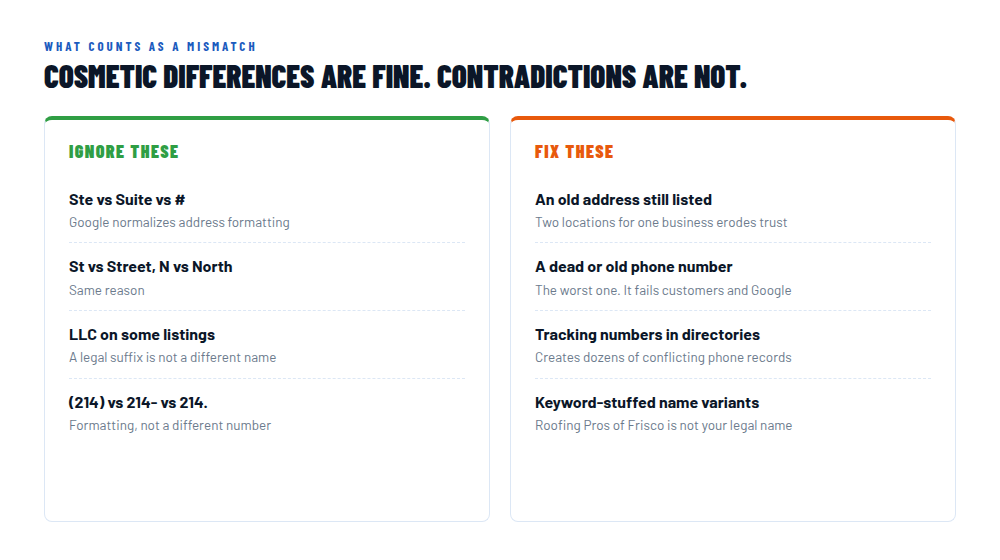
Ignore these: Ste versus Suite versus the # symbol. Street versus St. North versus N. Your name with and without LLC. Phone formatting with parentheses, dashes, or dots. None of it registers as a different business.
Fix these: an old address still live anywhere, a disconnected or previous phone number, call tracking numbers submitted to directories, and name variants with keywords bolted on. Those are contradictions, not formatting, and contradictions are what erode Google's confidence and misdirect customers.
Tracking numbers deserve a special mention because they are self-inflicted. A tracking number on your own website, configured correctly with the real number in your schema markup, is fine. A tracking number submitted to directories creates dozens of conflicting phone records that outlive the campaign they were created for.
The one-hour citation audit
You do not need a tool subscription for this. You need your real NAP written down and a browser.
- Write down your canonical NAP: the exact business name, address, and phone on your Google Business Profile. That is the version everything else should match.
- Search Google for your business name plus your phone number in quotes. Everything that comes back should match. Note what does not.
- Now search your name plus your old phone number, and your name plus your old address, if you have either. This is where the real problems live, and almost nobody thinks to look.
- Check the Tier 1 six by hand: Google, Apple, Bing, Yelp, Facebook, Nextdoor. Claim anything unclaimed while you are there.
- Fix in order of damage: old addresses first, dead phone numbers second, name variants third. Cosmetic formatting last or never.
- For anything that keeps coming back after you fix it, the source is upstream. Correct your record with the data feeders and give it a few weeks.
If you moved or changed numbers in the last three years, budget a second hour. Old data has roots.
What to skip
Skip the 300-directory submission packages. Most of those directories exist only to sell listings, have no visitors, and in some cases live in neighborhoods of the web you do not want your name in. We have watched brand-new sites accumulate hundreds of spam directory backlinks from exactly these services, and the cleanup costs more than the submissions did.
Skip monthly citation maintenance fees for static listings. A citation is not a subscription. Once it is correct, it stays correct until something about your business changes, and you already know when that happens because you are the one who changed it.
Skip any provider that will not tell you exactly which directories you are paying for. A list they will not show you is a list they do not want you to see.
Vagueness about deliverables is the same tell across every kind of SEO purchase, which is why it is the first thing we test in how to choose an SEO company.
When citations move the needle, and when they will not
Citation work produces visible results in a few specific situations. A new business with no footprint yet, where the core twenty establish that you exist. A business that moved, rebranded, or changed numbers, where old data is actively contradicting new. And a business whose profile keeps getting overwritten by wrong details, which is almost always an upstream feeder problem.
If none of those describe you, and your listings already agree with each other, more citation work will do approximately nothing. That is not a reason for disappointment. It is a box you get to check once and stop paying for, which frees the budget for the things that compound: content and site work, review velocity, and an actively managed Google Business Profile. If you are trying to work out what that budget should be, we broke down what SEO actually costs a local business and what each band buys.
Citations are also step one of a bigger diagnostic. If your listing agrees with itself everywhere and you are still invisible, the problem is elsewhere, and we wrote up the eight causes worth checking in order.
Frequently asked questions
How many citations does a local business actually need?
Around twenty done correctly: the six core platforms, the major data feeders, and the industry and local listings specific to your trade. Past that, additional citations add volume without adding trust, and the return drops to roughly zero.
Do local citations still matter for SEO?
Yes, but as a foundation rather than a lever. Consistent citations support the trust Google places in your Business Profile. They stopped being a way to outrank anyone about a decade ago, and anyone selling them as one is selling the past.
Should I pay for a citation building service?
Paying someone for the initial cleanup can be worth it, especially after a move or rebrand, because the work is tedious rather than difficult. Paying monthly to maintain static listings is not. Ask exactly which directories are included and what changes month to month, and watch how the conversation goes.
How long until citation fixes show results?
Direct fixes on major platforms register within days. Corrections pushed through data feeders take weeks to propagate. Ranking impact, where there is any, typically shows inside 30 to 60 days. If someone promises ranking movement from citations alone in a week, that is a red flag.
What about AI search tools recommending businesses?
Consistent citations help here too. AI assistants pull business details from the same public sources Google does, and a business whose name, phone, and address agree everywhere is a safer answer for them to give. It is the same trust problem wearing a new interface.
Should I delete listings on directories I do not recognize?
If the details are correct, leave them. A correct listing on an obscure directory is harmless. Spend the effort fixing listings that are wrong, and only pursue removal for listings that are wrong and refuse to be corrected.
Want your citations checked for you?
Our free audit covers your website, your Google Business Profile, and where your business details disagree with each other across the web. You get the issues ranked by impact. If everything already agrees, we will tell you that.
Start a conversationRead this next
How Much Does SEO Cost? →Local to Frisco?
Our Frisco SEO company page →